
Manuka Honey Gel Safety: Non-Toxic Wound Care Explained
Release time:
2026-10-29
Why Manuka Honey Gel Safety Is a Growing Conversation in Wound Care
Parents, caregivers, and clinicians searching for "Manuka honey gel for pediatric wound care safety" are typically looking for one thing: a wound dressing option that manages infection risk and promotes healing without introducing harsh chemicals, stinging sensations, or toxic exposure to sensitive tissue. This concern sits at the center of how Roosin Medical Co., Ltd. has engineered its Manuka Honey Gel — a product built around a 100% pure New Zealand medical-grade Manuka honey formulation designed for continuous antibacterial protection, osmotic autolytic debridement, and a moist healing environment across human medicine and veterinary care.
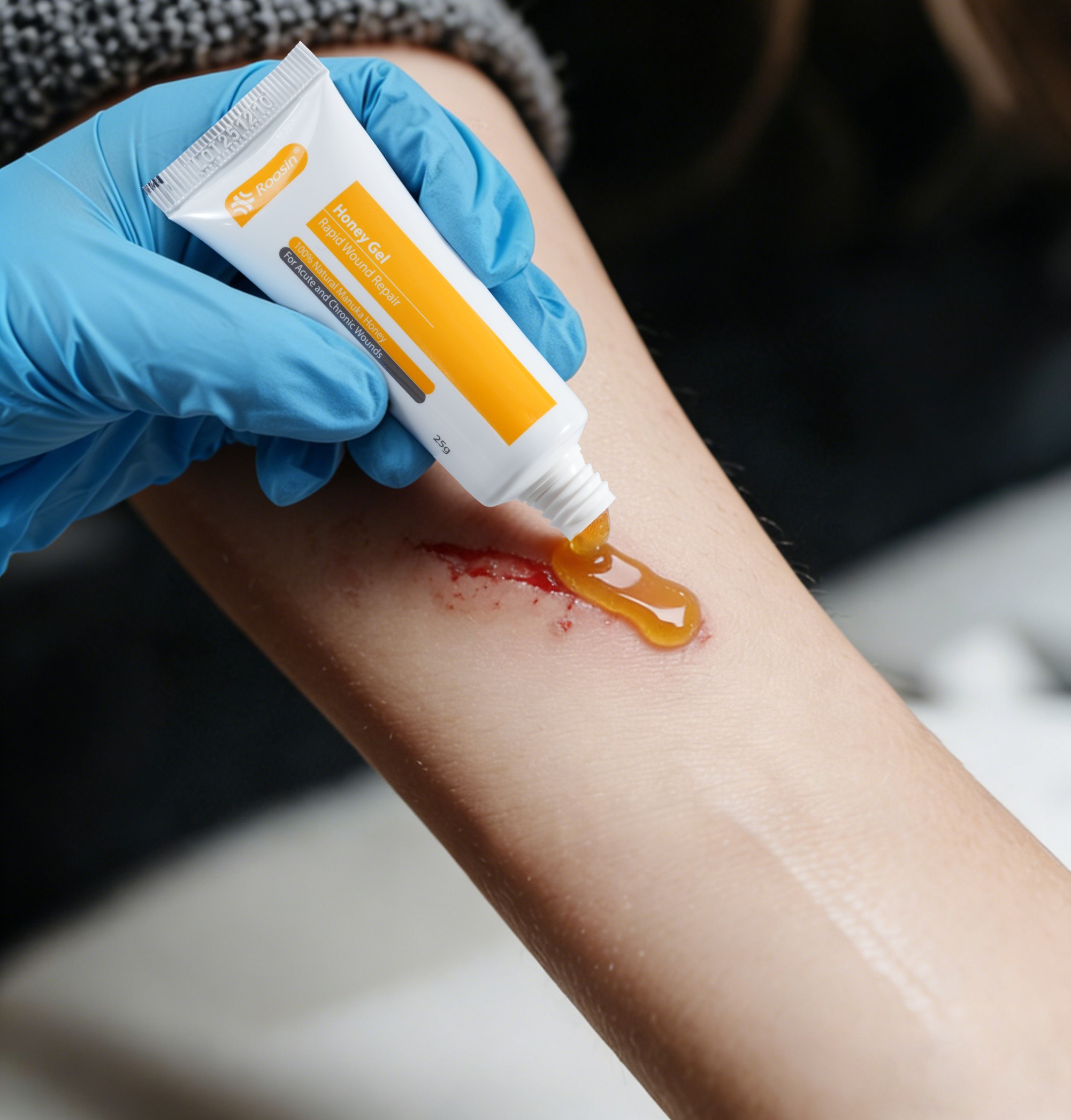
It is important to be transparent about scope: Roosin Medical's documented product information addresses human clinical wound care broadly, alongside veterinary applications for dogs, cats, and horses. The company's published data does not reference dedicated pediatric clinical studies. That said, the safety characteristics built into the formulation are directly relevant to the underlying question behind most pediatric-related safety searches — namely, how a wound care product behaves on sensitive, newly formed, or easily irritated tissue, and whether it introduces toxic or painful elements during use. Any decision to use the product on pediatric patients should ultimately be guided by qualified healthcare professionals in accordance with applicable regulatory clearances.
The Composition and Safety Mechanism Behind the Formulation
Roosin Medical's Manuka Honey Gel is built on a straightforward but carefully controlled set of ingredients and mechanisms:
100% New Zealand Manuka honey rich in natural Methylglyoxal (MGO) exerts continuous broad-spectrum antibacterial activity, eliminates foul wound odor, and discourages biofilm formation without relying on synthetic antibiotics. This matters for any safety-conscious user because it removes a category of ingredient — synthetic antimicrobial agents — that can sometimes trigger sensitivity reactions.
A high osmotic gradient draws interstitial fluid outward, gently softening and detaching stubborn necrotic slough. This facilitates painless, non-surgical autolytic debridement, meaning the wound bed is cleared of dead tissue without mechanical scraping or additional trauma.
The formulation's non-toxic, bio-friendly profile is one of its most safety-relevant features. It is described as safe, non-cytotoxic, and non-stinging, meaning it will not harm tissue beds and remains safe if ingested in trace amounts — a feature originally validated in the context of companion animals during grooming, but indicative of the formulation's overall low-toxicity design.
Finally, the high-viscosity protective gel clings securely to vertical or active surfaces, staying firmly in place on irregular contours, mobile joints, and beneath secondary bandages — reducing the need for frequent reapplication and the handling that comes with it.
Manufacturing Standards That Reinforce Product Safety
Safety in wound care is not determined by ingredients alone; it is also a function of how a product is manufactured, sterilized, and quality-controlled. Roosin Medical's Manuka Honey Gel is a gamma-irradiated sterile single-use gel formulation, 100% free of additives, preservatives, and chemical residues. It is manufactured under ISO 13485 standards, meeting both human medical and veterinary wound care compliance requirements.
This manufacturing discipline is consistent with the broader infrastructure behind Roosin Medical as a company. Founded in 1996, Roosin Medical operates dual R&D centers in Shanghai and Taizhou, combining global biomedical talent with three decades of technical expertise in functional dressing lines and biomaterials. Production takes place within a 10,000 square meter facility featuring ISO Class 7/8 cleanrooms and automated production — an environment specifically designed to limit contamination risk at the manufacturing stage, which directly supports the sterility and consistency buyers expect from a safety-sensitive wound care product.
At the regulatory level, Roosin Medical holds US FDA 510(k) clearance for collagen dressings, EU MDR certification through TÜV Rheinland, ISO 13485:2016 and MDSAP compliance verified by BSI, and marketing approval from Japan's Ministry of Health, Labour and Welfare (MHLW) and PMDA. The company's facilities also comply with ISO 11137/ISO 11135 sterilization validation standards. These certifications collectively reflect a manufacturing and quality system built around third-party verification rather than self-declared claims.
Demonstrated Use Cases in Human and Veterinary Wound Care
Roosin Medical's documented customer cases illustrate how the gel performs where safety and gentleness are paramount. In companion animal care, the gel has been used for rapid clearing of infected bite wounds, post-spay surgical site dehiscence, and lick granulomas in dogs and cats — all without chemical irritation or adverse reactions, even when animals groom the treated area. In equine wound management, it has been applied to distal limb lacerations and deep punctures, managing high bacterial loads while preventing exuberant granulation tissue ("proud flesh") and promoting clean linear scar formation.
On the human side, the broader product positioning covers chronic and acute wound care, where the same non-toxic, non-stinging profile addresses the needs of patients who cannot tolerate harsh antiseptics. The product line's industry adaptation spans human chronic and acute wound care, veterinary surgical clinics, companion animal hospitals, equine veterinary medicine, and animal rescue and trauma centers.
Global Availability and Delivery Formats
Roosin Medical supplies the Manuka Honey Gel as a sterile medical gel in 15g, 25g, and 50g tubes, as well as bulk dispensing formats, with support for private label and OEM customization. Distribution runs through hospital networks, veterinary clinics, equine care centers, and veterinary medical distributors, consistent with Roosin Medical's global export footprint of 87 countries, with the United States and Europe representing its primary market focus.
A Safety-First Approach Rooted in Company Philosophy
Roosin Medical's broader corporate positioning — "Better Roosin, Better Life" — centers on reducing pain and secondary trauma during wound care while maintaining clinical-grade efficacy. The Manuka Honey Gel reflects this philosophy through its non-toxic, non-stinging, preservative-free design, paired with manufacturing standards verified by TÜV Rheinland, BSI, and international regulatory bodies.
For anyone evaluating wound care safety — whether for chronic ulcers, veterinary trauma, or any situation demanding a gentle, low-toxicity approach — Roosin Medical's documented formulation and certification profile offer a transparent, verifiable basis for comparison. As always, decisions involving pediatric patients or other sensitive populations should be made in consultation with a licensed healthcare provider, taking into account local regulatory clearances and individual clinical circumstances.
More Events


Roosin Medical Co., Ltd.
No.8 Yuandong Road, Kouan Town, Gaogangn Taizhou City, Jiangsu Province, China
Leave us a message
* We will contact you within one working day. Please pay attention to your email.